Tarot card meanings / Swords / Five of Swords
Minor Arcana · Swords
Five of Swords Tarot Card Meaning
A win that costs more than it gives. The Five of Swords is conflict where someone comes out on top, everyone loses something, and being right feels hollow.
Upright
- hollow victory
- conflict
- winning at a cost
- pride
- humiliation
- walking away
Reversed
- making amends
- letting it go
- lingering resentment
- reconciliation
- choosing peace over winning
See the astrology & tradition
Venus is the planet of love and what we value; Aquarius is cool, detached and principled. Read together: warmth lost to the need to be right.
The deeper meaning
Fives break the steadiness of the fours. In every suit this is the rough middle: something is lost, contested or thrown off balance. In Swords, the suit of words and minds, the Five is the argument. Not the thought or the grief or the rest, but the moment two people turn their minds on each other and one of them wins.
In real life you know this card by the silence afterwards. You made your point and the room went quiet. You got the apology, the refund, the last word, the promotion over a colleague, and none of it feels the way you thought it would. Or you’re on the other side: walking away with your head down, too tired to keep fighting.
You can win the argument and lose the person you were having it with.
The card doesn’t say conflict is wrong. Some things are worth fighting for, and some people will only respect a firm line. It asks a narrower question: what did this particular win cost, and who is still standing next to you now that it’s over?
Handled well, the Five of Swords is a hard lesson taken honestly. You notice the cost, you apologize where you need to, you pick your battles better next time. Handled poorly, it becomes a pattern: collecting wins, keeping score, being right at the expense of being close. Sometimes the bravest move in this card is to be the one who walks away.
When this card appears
- Questionwhether this is a fight worth winning.
- Countwhat the win will cost, before you make it.
- Admityour part, even if the other side’s part was bigger.
- Walk awayfrom a fight that can only be won by becoming someone you don’t like.
- Repairwhat can be repaired. An apology is not a defeat.
Feya After Dark
In the Feya card
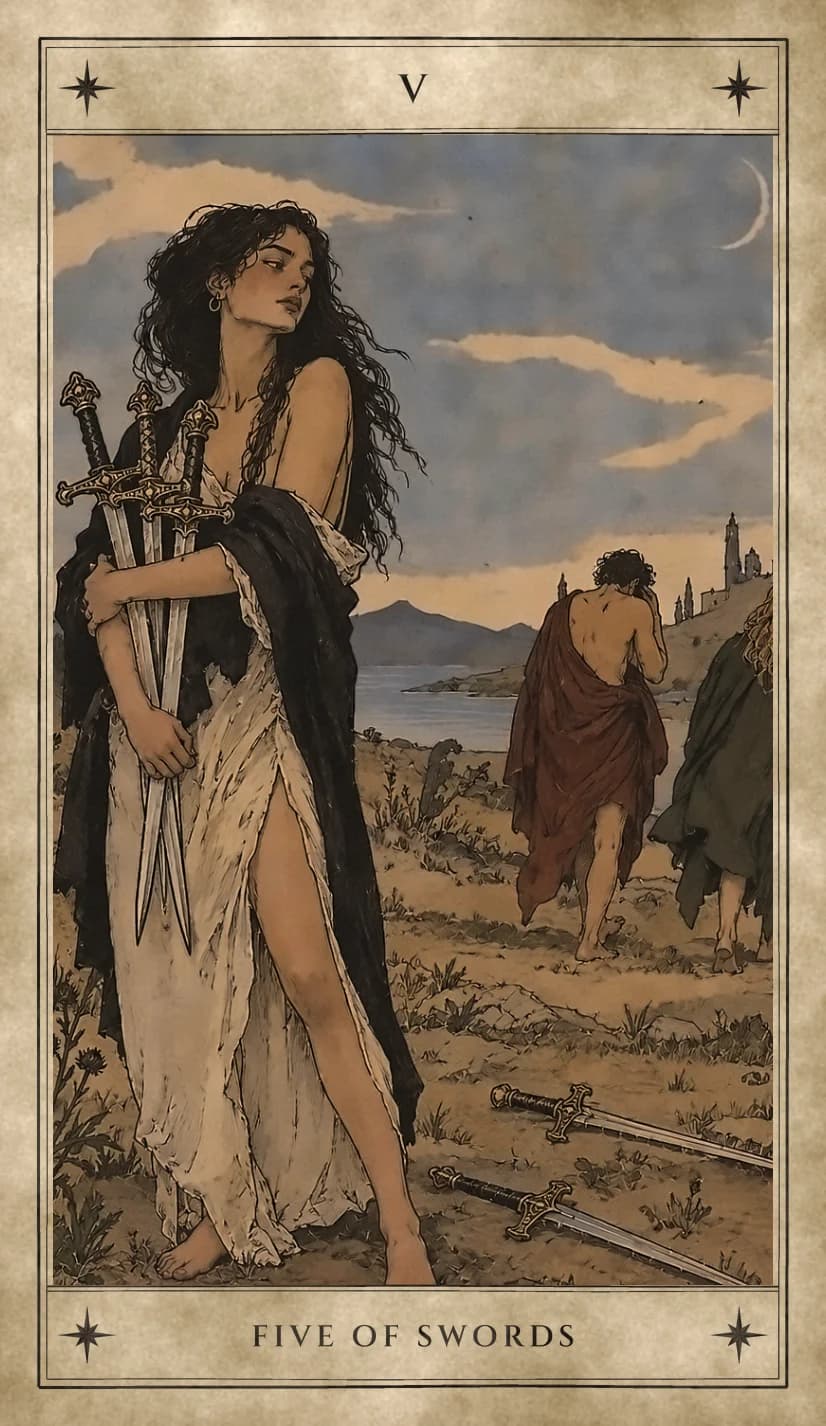
Our Five of Swords is quieter than most versions. There’s no grinning victor here. The woman in front has the swords, and she doesn’t look happy about it. She’s holding three of them against her body like something heavy she can’t put down, and glancing back over her shoulder with lowered eyes.
The three swords are clutched, not raised. Whatever she won, she’s now carrying it.
The two swords on the ground have been dropped in the dirt. Someone gave up, or was made to.
The two figures walking away have their backs to her. One, in red, holds his head in his hand. They’re heading toward the water and the town on the hill, back to ordinary life, without her.
Her cloak is slipping off her shoulders and her white dress is torn. She’s barefoot on dry, thistly ground. Winning hasn’t left her untouched.
The crescent moon hangs thin in the evening sky. Things are waning. The fight is over, and what’s left is the quiet after it.
Love & relationships
In love the Five of Swords points to conflict that has turned into point-scoring: arguments one of you wins and both of you lose, pride getting in the way of closeness, or a breakup where nobody behaved well.
If it's new
Watch how disagreements go early on. Someone who needs to win every small argument now will probably need to win the big ones later. That includes you.
If you're together
You may be fighting to be right instead of fighting for the relationship. Keeping score, bringing up old wins and losses, saying the cutting thing because it’s true. The card suggests stepping out of the contest. Ask what you both need, not who was right.
If you're apart
The ending may have been ugly, and it can be tempting to keep winning it: in your head, to friends, online. You don’t need them to agree with your version. Let the argument end, even if nobody declares a winner.
Career & work
Office politics, a conflict with a colleague, a negotiation that got personal, or a win that damaged a working relationship. Be careful about taking credit, cutting corners on fairness or burning bridges you may need later. If you’re on the losing side, it may be wiser to leave the field than to keep fighting on ground that was never fair.
Money
A dispute about money, a deal where someone got the better of someone else, or a financial win that came with a hidden cost. Get agreements in writing. If it’s become a real dispute, proper advice is worth more than being right. Not every argument over money is worth its legal or emotional bill.
The last word is a lonely place to stand.
Inner life
Many people learned early that winning was how you stayed safe. The Five of Swords can show you where that old lesson still runs. Inwardly, it asks for a kind of honesty that’s harder than being right: admitting when you wanted to hurt, admitting when you were hurt and struck back. Letting go of a fight isn’t losing it. Sometimes it’s the only way to leave the battlefield with yourself intact.
Reversed
Reversed, the fight is winding down, or going underground. It can mean:
- Making amends. Someone reaches out, apologizes or offers to talk. The swords are being laid down.
- Letting it go. You stop needing to win. It feels like losing at first, then like relief.
- Resentment kept. The argument is over on the surface, but someone is still carrying it.
- Walking away for good. Choosing to leave a situation where fairness was never going to happen.
Next to the Two or Six of Cups, reversed conflict leans toward reconciliation. Next to the Seven of Swords, toward grudges and quiet revenge.
Questions to ask yourself
- What did I win recently that doesn’t feel like winning?
- Who am I still arguing with in my head?
- What would it cost me to let this one go?
- Is there an apology I owe, or one I’m waiting for?
- What do I actually want here: to be right, or to be close?
Related cards
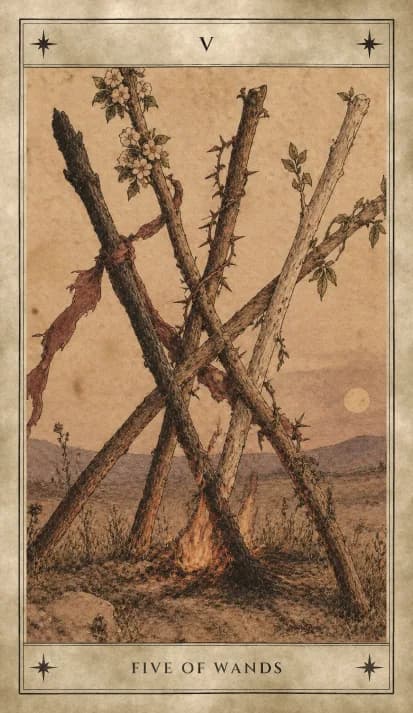 Five of WandsThe same conflict while it was still just friction.
 Seven of SwordsAnother way of winning that avoids a fair fight.
 Ten of SwordsWhere conflict ends up if nobody stops it.
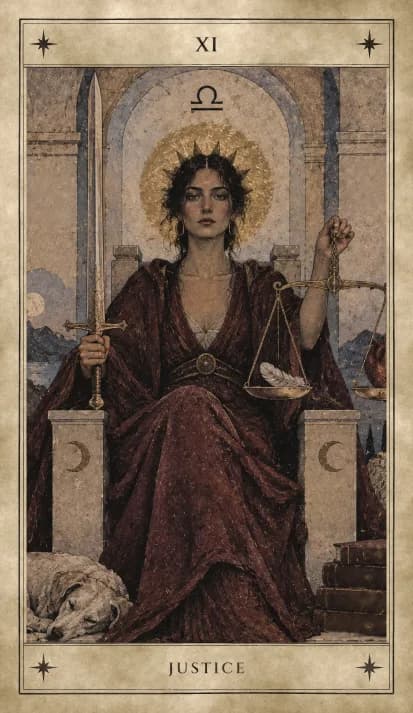 JusticeFairness weighed instead of victory claimed.
 Two of CupsRepair: choosing the bond over being right.
 Six of SwordsLeaving the field and taking what’s left of you with you.
Short answers
Is the Five of Swords a yes or no?
It leans no, or “not at that price”. You might win, but the card questions whether the win is worth what it costs. If getting a yes means a fight, it asks you to think twice.
What does the Five of Swords mean in love?
Conflict, pride and point-scoring. It can mean arguments that nobody really wins, a painful breakup, or a relationship where being right has become more important than being kind. It’s a call to stop fighting the other person and start working on the problem.
What does it mean as feelings, or how someone sees me?
There’s tension, hurt pride or resentment. They may feel defeated, or feel they need to win. It can describe someone who is still angry about an argument, even if they haven’t said so.
Am I the winner or the loser in the Five of Swords?
It can be either, and it’s worth asking honestly. Some readers see themselves in the one holding the swords, some in the ones walking away. Often it’s both at different times. The card’s question is the same either way: what has this conflict cost?
Is the Five of Swords an Aquarius card?
In the Golden Dawn system it rules the first decan of Aquarius, Venus in Aquarius, roughly January 20 to 29. Its old title is “Lord of Defeat”. Some readers use decans for timing. We offer it as tradition, not prediction.