Tarot card meanings / Swords / Ten of Swords
Minor Arcana · Swords
Ten of Swords Tarot Card Meaning
Rock bottom, and the end of falling. The Ten of Swords marks a painful ending that is finally complete: the worst has happened, and the only way now is up.
Upright
- rock bottom
- a painful ending
- the worst is over
- defeat
- exhaustion
- finality
Reversed
- slow recovery
- getting up again
- refusing to let it end
- surviving the worst
- reopening what’s finished
See the astrology & tradition
The Sun is the planet of the self and of light; Gemini is the sign of the mind. Read together: a way of thinking that ends completely, so that something clearer can begin.
The deeper meaning
Tens close a suit. Everything the numbers have been building reaches its end point. In Cups that ending is a full house; in Pentacles, a legacy. In Swords, the suit of the mind, words and truth, it’s the moment a story finishes, completely and without appeal. After the sleepless fear of the Nine, the Ten is what it feels like when the thing you feared actually arrives.
And strangely, that can be a relief. Anyone who has lived through a long ending knows this: the dread was worse than the fall. When the job is finally gone, the relationship finally over, the secret finally out, there’s a flat, exhausted quiet. No more waiting. No more hoping it won’t happen. It happened.
Rock bottom is still a floor. You can stand on it.
The card looks brutal, and it’s dramatic on purpose. Ten swords is far more than it takes. That excess is part of the message: this isn’t a wound to be managed or argued with. It’s over. The card doesn’t point to literal harm. It points to an ending so complete that you can stop fighting it.
Handled well, the Ten of Swords is where you stop bargaining. You let the thing be finished, rest the way the exhausted need to rest, and notice that you are still here. Handled poorly, you keep reopening it: retelling the ending, relitigating it, refusing to leave the shore. The card isn’t asking you to get up today. It’s asking you to accept that you won’t fall any further.
When this card appears
- Acceptthat this part is over, even though you didn’t choose it.
- Restproperly. You don’t owe anyone a quick recovery.
- Stop reopeningthe ending to check whether it still hurts.
- Ask forhelp with the practical things while you can’t manage them alone.
- Noticethe light already on the horizon, even if it doesn’t feel like yours yet.
Feya After Dark
In the Feya card
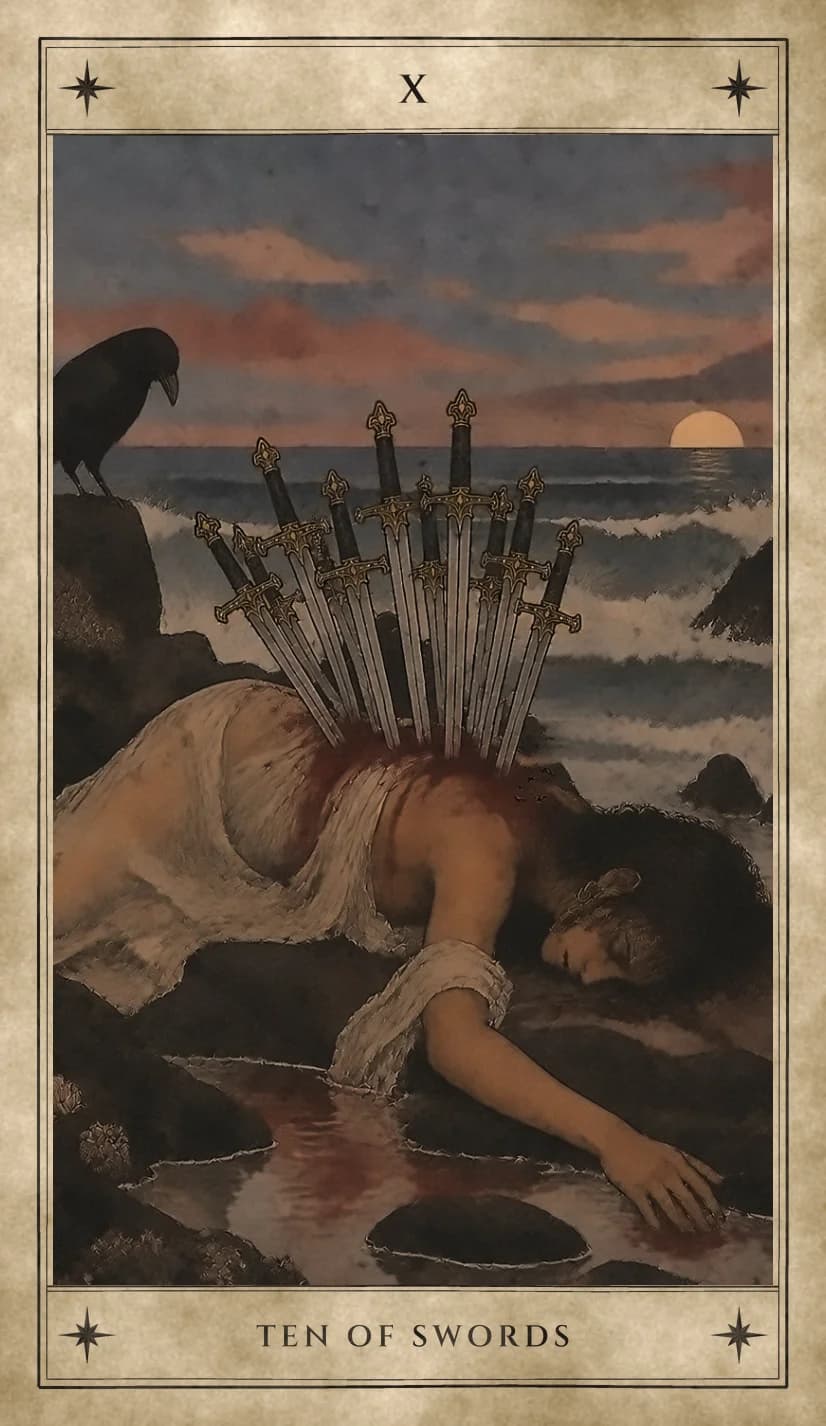
Our Ten of Swords happens at the edge of the sea. A woman lies face down on dark rocks with ten swords standing in her back. Her eyes are closed and her face is calm. One arm has slipped into a tide pool, the fingers resting in the water. It’s the stillest card in the suit: the fight is over.
The ten swords fan out from her back like a crest, far more than any one blow would need. The excess is deliberate. This isn’t a wound to be treated. It’s an ending to be recognized.
The raven on the rock above looks down at her. As in our Three of Swords, it’s a witness, not a threat. What happened here has been seen. It isn’t going unrecorded.
The tide pool has taken some of the blood, and the tide will take the rest. The waves behind her keep coming in. Whatever this was, it won’t stay exactly like this.
On the horizon, the sun sits half above the water under pink clouds. The card doesn’t say whether it’s rising or setting, and readers disagree. We read it as both: one day ending, the next already on its way.
Love & relationships
In love, the Ten of Swords usually marks an ending that has already happened or can no longer be put off. It’s painful to draw. It’s also honest, and it often brings the particular relief of no longer having to hope.
If you’re single
You may be carrying the exhaustion of the last ending into this season. That’s allowed. The card doesn’t ask you to date. It asks you to stop treating the last story as unfinished.
If you’re together
Something in the relationship has reached its end point. That might be the relationship itself, or a pattern, a way of fighting, a version of the two of you that can’t continue. Don’t decide the scale from a card. Talk honestly about what is actually over.
If you’re apart
It’s over, and the card is plain about that. It doesn’t say you were wrong to love them, or that you’ll feel like this forever. It says there’s nothing left to win back here, and that rest is more useful now than hope.
Career & work
A job lost, a project cancelled, a reputation knocked, a burnout that finally made you stop. It can feel like the end of a whole version of your working life, and sometimes it is. Let yourself be tired. Deal with the practical things one at a time, and don’t decide who you are professionally from the lowest point.
Money
A loss that’s complete: the deal fell through, the debt came due, the money is gone. Painful, and often clearer than the months of worry before it. Get the facts in one place, ask for qualified help if it’s serious, and make the next small decision rather than the whole plan.
An ending that’s finished weighs less than one you’re still holding up.
Inner life
That’s the quiet gift of this card. Much of the pain before the Ten was the effort of holding together things that were already coming apart. When you finally stop, the exhaustion shows. So does something else: the part of you that survived. The inner work here isn’t rebuilding yet. It’s letting yourself be someone this happened to, without letting it have the last word.
Reversed
Reversed, the Ten of Swords is usually about what happens after the bottom. It can mean:
- Getting up, slowly. The worst is behind you. You’re not recovered, but you’re moving, and you notice good days again.
- Refusing the ending. Holding on to something that’s already over: trying to revive it, explain it away or win the argument after the fact.
- Surviving, and surprised by it. You got through what you thought would finish you. That knowledge will matter later.
- A fall still coming. Less often, the ending hasn’t fully landed yet, and putting it off is only making it longer.
Which one it is often depends on the cards around it. Next to the Six of Swords or the Star, it leans toward recovery. Next to the Nine of Swords, toward a mind still living inside the ending.
Questions to ask yourself
- What has actually ended, as plainly as I can say it?
- What am I still trying to save that’s already gone?
- What do I need most right now: rest, help or time?
- What in me survived this?
- What would it mean to stop fighting it?
Related cards
 Nine of SwordsThe fear before the fall, bigger in the dark.
 The TowerCollapse that comes all at once, not at the end of a long slide.
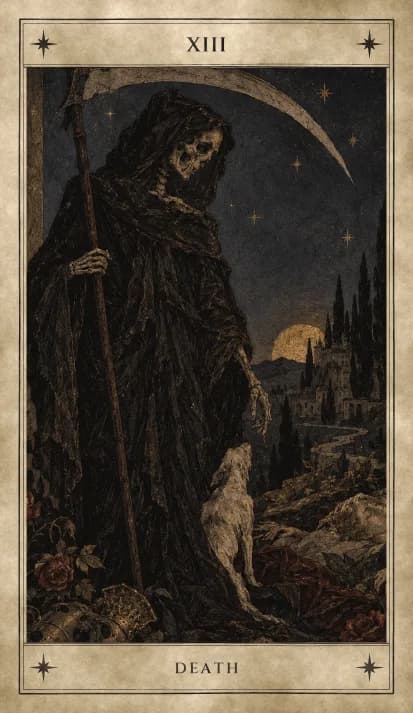 DeathAn ending read as transformation, not only loss.
 Six of SwordsLeaving the shore for calmer water.
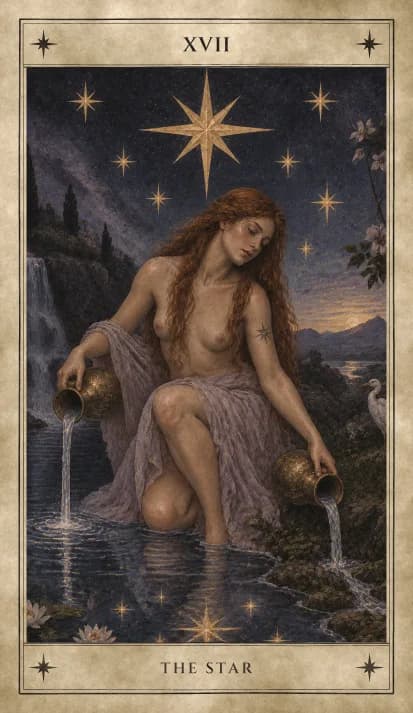 The StarWhat begins when the ending is fully accepted.
 Ace of SwordsThe clear new thought that follows a finished story.
Short answers
Is the Ten of Swords a yes or no?
It leans no, especially if you’re asking whether something can be saved or revived. The card says the ending is complete. That’s hard to hear, and it can also free you to ask a better question: what now?
What does the Ten of Swords mean in love?
Usually an ending: a breakup, a betrayal fully revealed, or a pattern that can’t continue. It’s painful, and it’s final in a way that can bring relief. It doesn’t say you’ll never love again. It says this particular story has finished.
What does it mean as feelings, or how someone sees me?
They may feel defeated, exhausted or finished with the situation. It can describe someone at their lowest point, or someone who has already decided it’s over. It doesn’t say how they feel about you as a person.
Does the Ten of Swords mean death?
No. It shows a dramatic ending, not a literal one. Tarot is a tool for reflection, not a prediction of harm. Readers take it as the end of a situation, a belief or a chapter, and many find it quietly hopeful: the worst is behind you.
Is the Ten of Swords a Gemini card?
In the Golden Dawn system it rules the third decan of Gemini, the Sun in Gemini, roughly June 11 to 20. Some readers use decans for timing. We offer it as tradition, not prediction.