Tarot card meanings / Wands / Five of Wands
Minor Arcana · Wands
Five of Wands Tarot Card Meaning
Friction, not war. The Five of Wands is competition, argument and clashing wills: noisy and tiring, but usually about everyone wanting to be heard more than anyone wanting to win.
Upright
- friction
- competition
- disagreement
- clashing egos
- rivalry
- restless effort
Reversed
- avoiding conflict
- tension gone underground
- a truce
- infighting turning personal
- worn out by friction
See the astrology & tradition
Saturn is limits and pressure; Leo is pride and self-expression. Read together: strong wills in a space that’s too small, all wanting to shine at once.
The deeper meaning
Fives are where the stability of the Four breaks. In every suit something gets unsettled: loss in Cups, hardship in Pentacles, a bad win in Swords. In Wands, the suit of will and drive, the break is friction. Everyone has fire now, and they’re all in the same room.
It feels like a group chat that won’t calm down, a team where every idea gets challenged, a family weekend where everyone has an opinion about the seating plan. It’s loud. It’s tiring. It is rarely as dangerous as it feels while you’re in the middle of it.
Friction is what happens when everyone cares at once.
The Five of Wands is about competition in the broad sense: people jostling for space, attention, credit or the last word. Some of that is healthy. Sparring sharpens ideas, and a little rivalry gets people moving. The trouble starts when the point becomes winning rather than building.
Handled well, this card is lively disagreement: you say what you think, you let others do the same, and you look for the one thing everyone is actually fighting about. Handled poorly, it’s noise without end: scoring points, taking things personally, burning out on a contest nobody remembers the reason for. The card asks you to tell the difference between conflict that matters and conflict that’s only heat.
When this card appears
- Pickthe one argument that actually matters, and let the rest go.
- Listenfor what everyone is really fighting over.
- Step backfrom contests you don’t even want to win.
- Speak upif you’ve been drowned out: plainly, once.
- Channelthe competitive heat into the work itself.
Feya After Dark
In the Feya card
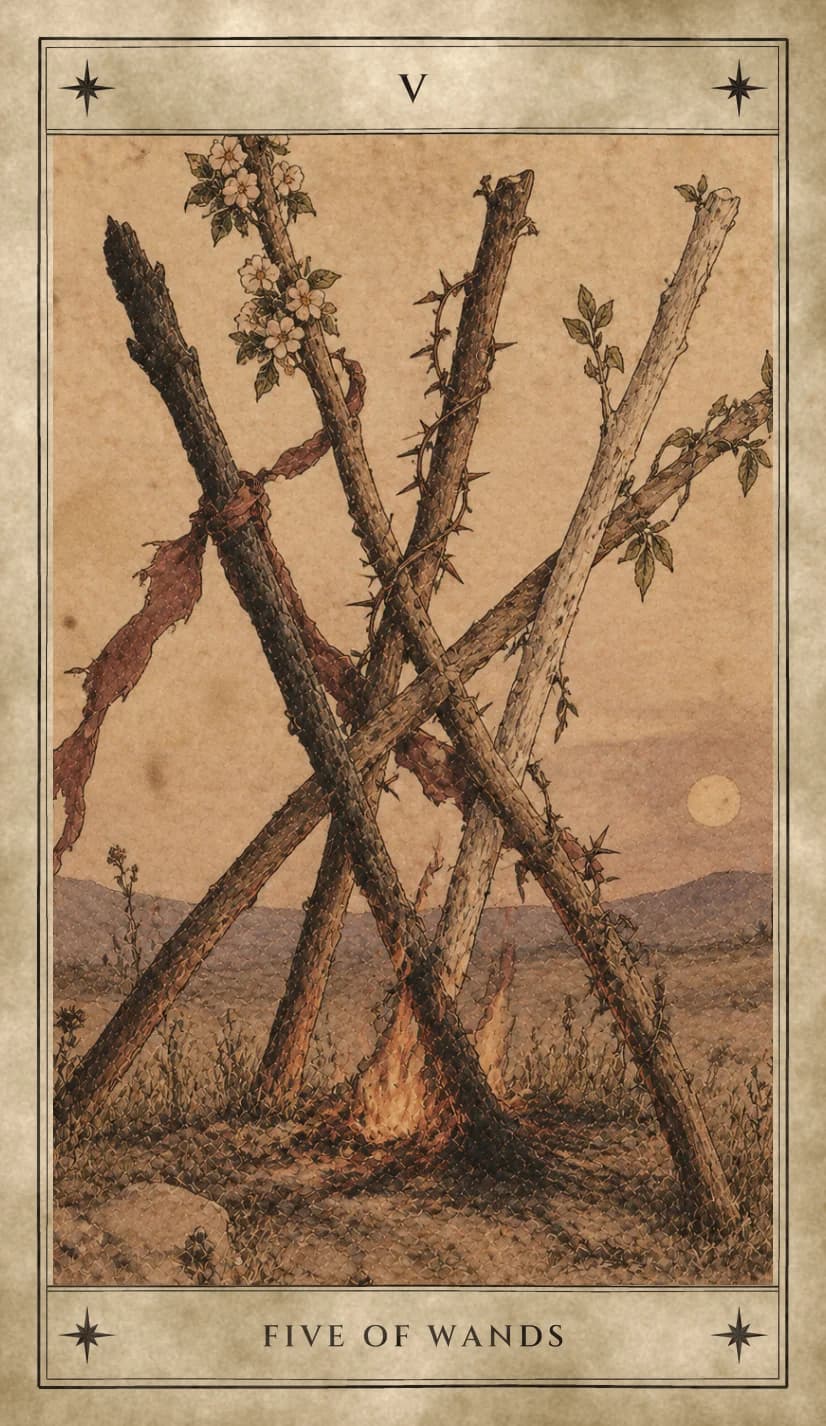
Our Five of Wands has no fighters in it at all. There are only the wands, five of them, leaning and crossing over a small fire on an open plain. Nobody is swinging a stick. The clash is in how they’re stacked: each one pushing against the others, and all of them holding each other up.
Five different woods. One is charred dark, one breaks into white blossom, one is wound tight with thorns, one is pale and bare, one is still in leaf. Five natures, five tempers. None of them is wrong. They just don’t match.
The small fire at their base is fed by the very thing that crowds them together. Put this many strong wills in one place and something catches. It can warm a room or burn it.
The torn red cloth knotted to one wand has been through something. Some friction leaves marks, even after it passes.
Around them, the plain is empty and the hills are low under a pale sun. There is space everywhere. The crush exists only where they’ve crowded in together.
Love & relationships
In love the Five of Wands usually means friction: bickering, crossed wires, competing needs or a power struggle. It can also mean the charged kind of tension, banter and sparks. Either way, it is rarely the end of anything on its own.
If you're single
Competing for someone’s attention, or a crowded field of options that keeps you from settling. It’s worth asking whether you’re drawn to the person or to winning.
If it's new
Sparks, pushback, a bit of testing. That can be chemistry. Notice whether it stays playful or starts to feel like a contest you have to win.
If you're together
Recurring arguments, often about small things standing in for a bigger one. Try naming what the fight is actually about: time, respect, being heard.
Career & work
Competition, clashing opinions, a team that can’t agree, a crowded market. It can be productive: debate often makes the work better. Keep your arguments about the work, not the people, and don’t spend all your fire proving a point.
Money
Competition for resources: bidding, negotiating, disagreements over who pays for what. Stay clear and factual. Money decisions made in the heat of an argument tend to be the ones people regret.
Friction only happens between things that are both still moving.
Inner life
Sometimes the five wands are all inside one person. Different parts of you want different things, loudly, and none of them will sit down. The Five of Wands asks you to let each voice be heard instead of shouting some of them down. Inner conflict is often a sign that you’re growing, not failing.
Reversed
Reversed, the friction hasn’t gone. It has usually changed shape. It can mean:
- Avoidance. Keeping the peace at the cost of saying what you think.
- Gone underground. No open arguments, just coldness, sulking or pointed silences.
- A truce. The fight is winding down and people are finding common ground.
- Worn out. Tired of contesting everything, and ready to stop.
Which one it is often depends on the cards around it. Next to Temperance, it leans toward resolution. Next to the Five of Swords, it may be tipping from friction into something that does real harm.
Questions to ask yourself
- What is this conflict actually about, under the noise?
- Which of these fights would I miss if I dropped it?
- Where am I competing when I could be working together?
- Whose voice, including my own, keeps getting drowned out?
- What would it take for me to be heard without having to win?
Related cards
 Four of WandsThe calm gathering before the full house got loud.
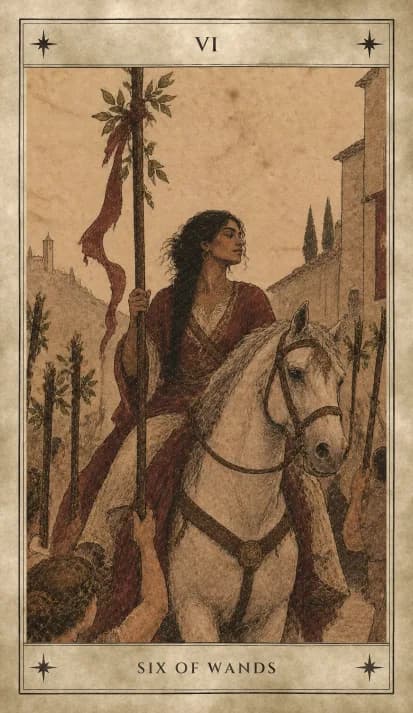 Six of WandsWhat the scramble looks like once someone comes out ahead.
 Seven of WandsThe same clash, with you alone on the high ground.
 Five of SwordsWhen winning starts to matter more than the people.
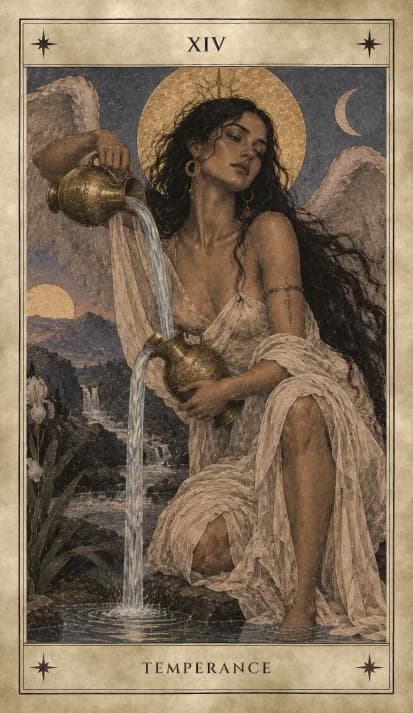 TemperanceThe patient art of blending what clashes.
Short answers
Is the Five of Wands a yes or no?
It depends. There’s competition or resistance around the question. It often means “yes, but you’ll have to push for it”, and it asks whether the contest is worth your time.
What does the Five of Wands mean in love?
Friction: arguments, crossed signals or a power struggle. Sometimes it’s the playful tension that comes with attraction. It’s rarely a verdict on the relationship by itself.
What does it mean as feelings, or how someone sees me?
They may feel challenged by you, frustrated, or a little competitive. It can also describe restless attraction: someone who enjoys the sparring more than they’d admit.
Is the Five of Wands a bad card?
Not really. It’s uncomfortable, but it’s one of the milder conflict cards. It describes friction and competition, which can be tiring but often sharpen things. It gets heavier next to cards like the Five of Swords.
Is the Five of Wands a Leo card?
In the Golden Dawn system it rules the first decan of Leo, Saturn in Leo, roughly July 22 to August 1. Some readers use decans for timing. We offer it as tradition, not prediction.