Tarot card meanings / Swords / Six of Swords
Minor Arcana · Swords
Six of Swords Tarot Card Meaning
Leaving the hard thing behind, slowly. The Six of Swords is a quiet crossing toward calmer water, carrying what you must, letting distance help you heal.
Upright
- transition
- moving on
- leaving
- calmer water
- recovery
- travel
Reversed
- unfinished business
- resisting change
- turning back
- carrying too much
- a delayed departure
See the astrology & tradition
Mercury is the planet of thought and travel; Aquarius sees things from a distance. Read together: a mind that can finally look at the situation from across the water.
The deeper meaning
Sixes bring a suit back toward balance after the upheaval of the fives. In Swords, that balance doesn’t come from winning the argument. It comes from leaving it. After the conflict of the Five, the Six is the boat pushing off from the shore.
In real life this is rarely a triumphant exit. It’s moving out with the boxes half-packed. It’s the first month in a new job, a new city or a new routine after something ended. It’s choosing to stop going back to the conversation, the place or the person that kept hurting. You’re sad, and you’re going anyway.
You don’t have to be healed to leave. Leaving is often how healing starts.
The swords come with you. That’s one of the most honest details in this card. You don’t get to leave your history on the shore. The lessons, the grief and the sharp memories are in the boat. But they’re upright and still now, not being swung. You carry them differently once you’re moving.
Handled well, the Six of Swords is a steady transition: accepting help, letting distance do its work, not demanding that you feel better by the time you reach the other side. Handled poorly, it becomes a kind of running, crossing the water again and again without ever landing. The card asks you to go, and also to arrive.
When this card appears
- Leavewhat keeps hurting you, even if you’re leaving slowly.
- Accepthelp with the crossing. Someone else can hold the pole for a while.
- Trustthat distance will make things clearer, even if it doesn’t yet.
- Stop looking backat the shore every few minutes to check it’s still there.
- Packonly what you truly need to bring.
Feya After Dark
In the Feya card
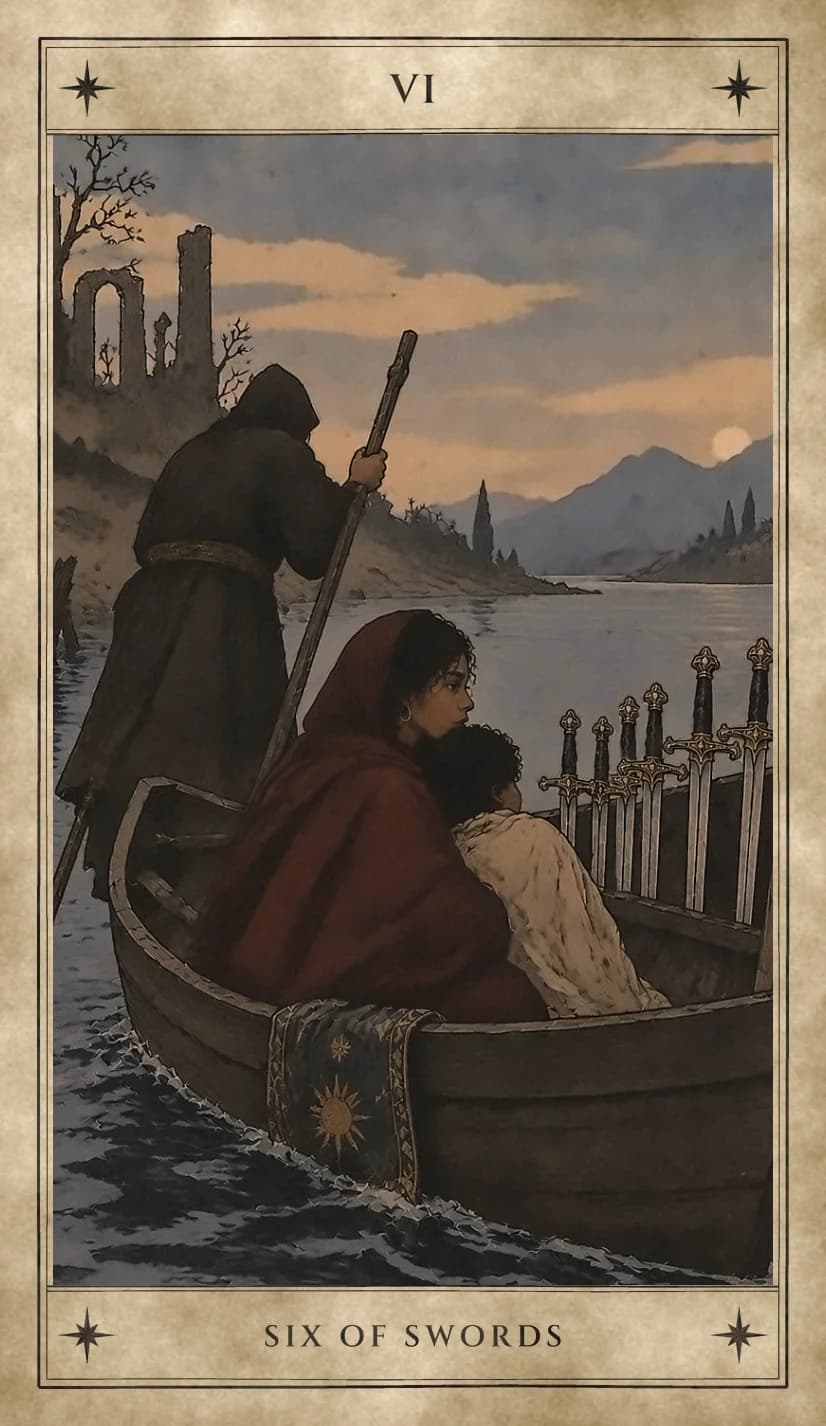
Our Six of Swords is a crossing at dusk. A small wooden boat moves across the water. At the back, a hooded ferryman in a dark robe leans on a long pole. In the middle, a woman in a red hooded cloak holds a child close, the child wrapped in pale cloth and turned into her shoulder.
The six swords stand upright along the side of the boat. They’re coming too. Nobody is using them now.
The ferryman faces away from us, his face hidden. He’s the help you don’t have to understand to accept: a friend, a therapist, time itself.
The woman and child can be read as two people, or as one: the adult part of you, looking after the younger part that’s frightened by the move. She looks out across the water. The child doesn’t have to look yet.
The cloth over the side is embroidered with a sun and stars. Even on a dark crossing, someone packed a little light.
Behind them, ruined arches and bare trees stand on the shore. Ahead, across the water, are mountains, cypresses and a low sun. The water around the boat is rough, and smoother further out.
Love & relationships
In love the Six of Swords usually points to moving on: leaving a relationship that hurt, moving through a hard patch together toward something calmer, or literally moving, a relocation or a distance to navigate.
If you're single
You may be leaving an old heartbreak behind, not in one bright moment, but day by day. The next relationship will be better for the distance you’re putting between you and the last one.
If you're together
You’re crossing something together: a move, a hard year, the aftermath of a rupture. It’s quiet and not always romantic. The card is encouraging. Calmer water is ahead if you keep rowing in the same direction.
If you're apart
This card usually doesn’t point back toward them. It points toward the far shore, a life where this no longer hurts the way it does now. Let yourself go there.
Career & work
Leaving a job or a team, a transfer, a gentle career change, or recovering after a difficult stretch at work. It’s not a card of sudden success, but of steady improvement. Moves for work, including relocations, are traditional meanings too. Take the help that’s offered. You don’t have to row alone.
Money
A gradual improvement, or moving away from a financial situation that was hurting you. Think about what you need to take into the next chapter and what you can leave behind. It may be a good time to simplify. The card doesn’t promise a windfall. It suggests steadier water ahead.
Some places you only leave by rowing away from them slowly.
Inner life
Slowness is the kindness in this card. Many people expect themselves to leave a painful time instantly and completely, and feel like failures when they still miss it. The Six of Swords allows for both: going forward and grieving what’s behind. Inwardly, it’s about getting a little distance from your own thoughts, enough to see them instead of drowning in them.
Reversed
Reversed, the crossing is stalled, or the boat keeps turning back. It can mean:
- Unfinished business. Something on the shore needs to be settled before you can really leave.
- Resisting the move. You know it’s time and you keep finding reasons to stay.
- Carrying too much. Taking every grievance and memory with you, until the boat sits low in the water.
- Turning back. Returning to the old situation, sometimes wisely, sometimes out of fear of the unknown.
Next to the Four of Swords, it may simply mean you need more rest before moving. Next to the Eight of Swords, it leans toward feeling unable to leave.
Questions to ask yourself
- What am I leaving, and what am I bringing with me?
- Who is helping me across, and have I let them?
- What would calmer water look like for me?
- What am I afraid to find on the other side?
- What part of me needs to be held while I make this change?
Related cards
 Five of SwordsThe fight you’re rowing away from.
 Four of SwordsThe rest that makes the crossing possible.
 Eight of CupsWalking away from what no longer holds you, on foot this time.
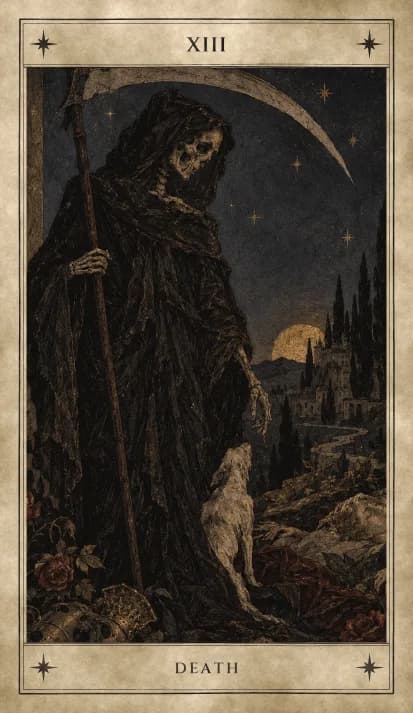 DeathThe larger ending this crossing belongs to.
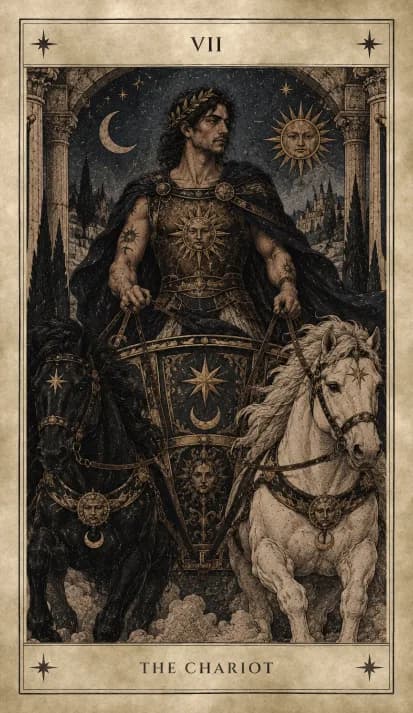 The ChariotMoving by force of will, instead of letting yourself be carried.
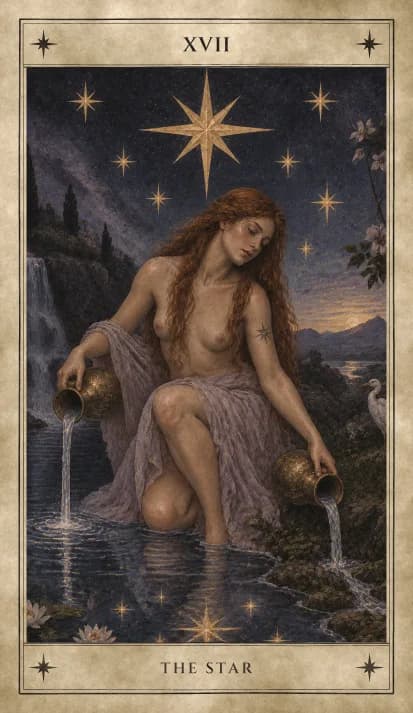 The StarWhat waits on the far shore.
Short answers
Is the Six of Swords a yes or no?
It leans yes, especially for questions about leaving, moving or changing direction. It’s a gradual yes, though. Things improve over time, not overnight.
What does the Six of Swords mean in love?
Moving on. It can mean leaving a painful relationship, a couple getting through a hard time together, or a relationship that involves a move or a distance. It points toward calmer water, not back toward the storm.
What does it mean as feelings, or how someone sees me?
They may be sad but moving forward. It can describe someone who is working through something quietly, or who sees you as part of a calmer chapter. It can also mean they’re putting distance between themselves and the situation.
Does the Six of Swords mean travel or moving house?
It can. Travel over water and relocation are traditional meanings. More often it describes an emotional move: leaving a difficult time behind. Let the rest of the reading, and your life, tell you which.
Is the Six of Swords an Aquarius card?
In the Golden Dawn system it rules the second decan of Aquarius, Mercury in Aquarius, roughly January 30 to February 8. Its old title is “Lord of Earned Success”. Some readers use decans for timing. We offer it as tradition, not prediction.