Tarot card meanings / Swords / Three of Swords
Minor Arcana · Swords
Three of Swords Tarot Card Meaning
Heartbreak you can't argue with. The Three of Swords names grief, betrayal or a hard truth that has already landed, and asks you to stop pretending it doesn't hurt.
Upright
- heartbreak
- grief
- a painful truth
- betrayal
- separation
- clarity through pain
Reversed
- slow healing
- grief held in
- reopening the wound
- beginning to forgive
- lingering hurt
See the astrology & tradition
Saturn is the planet of limits; Libra is the sign of partnership. Read together: the point where a relationship meets something that can't be negotiated.
The deeper meaning
Threes are where something stops being private. The Ace was an idea, the Two a decision you were still weighing. By the Three it has met the world and become real. In the suit of Swords, the suit of the mind, words and truth, what becomes real is usually something you now know and can't un-know.
That's why this card rarely feels like a surprise. More often it's confirmation: the message you half-expected, the conversation that finally happened, the grief you'd been bracing against that arrived anyway. The pain is real. Sometimes the pain is also the end of a long effort not to know.
The swords aren't the betrayal. They're the moment you let yourself understand it.
This is the card of the edge: the point where a relationship, a hope or a plan meets something that can't be negotiated, softened or charmed away. Nothing is punishing you. You've just found where the limit is.
Handled well, the Three of Swords is clean grief. You feel it, say it plainly, and let it be as big as it is. Handled poorly, the swords keep cutting: replaying the conversation, rereading the messages, turning a wound into an identity, or using the sharpness of your own words on someone else. The card isn't asking you to be over it. It's asking you to stop arguing with the fact that it happened.
When this card appears
- Noticewhere you're hurting, even if you've called it “fine”.
- Admitthe thing you already knew before it was confirmed.
- Protectyourself from the replay: the thread, the photos, the 2 a.m. re-reading.
- Stop avoidingthe conversation, or the tears, you've been postponing.
- Questionany big decision made in the first sharp hours.
- Releasethe story that you should be further along by now.
Feya After Dark
In the Feya card
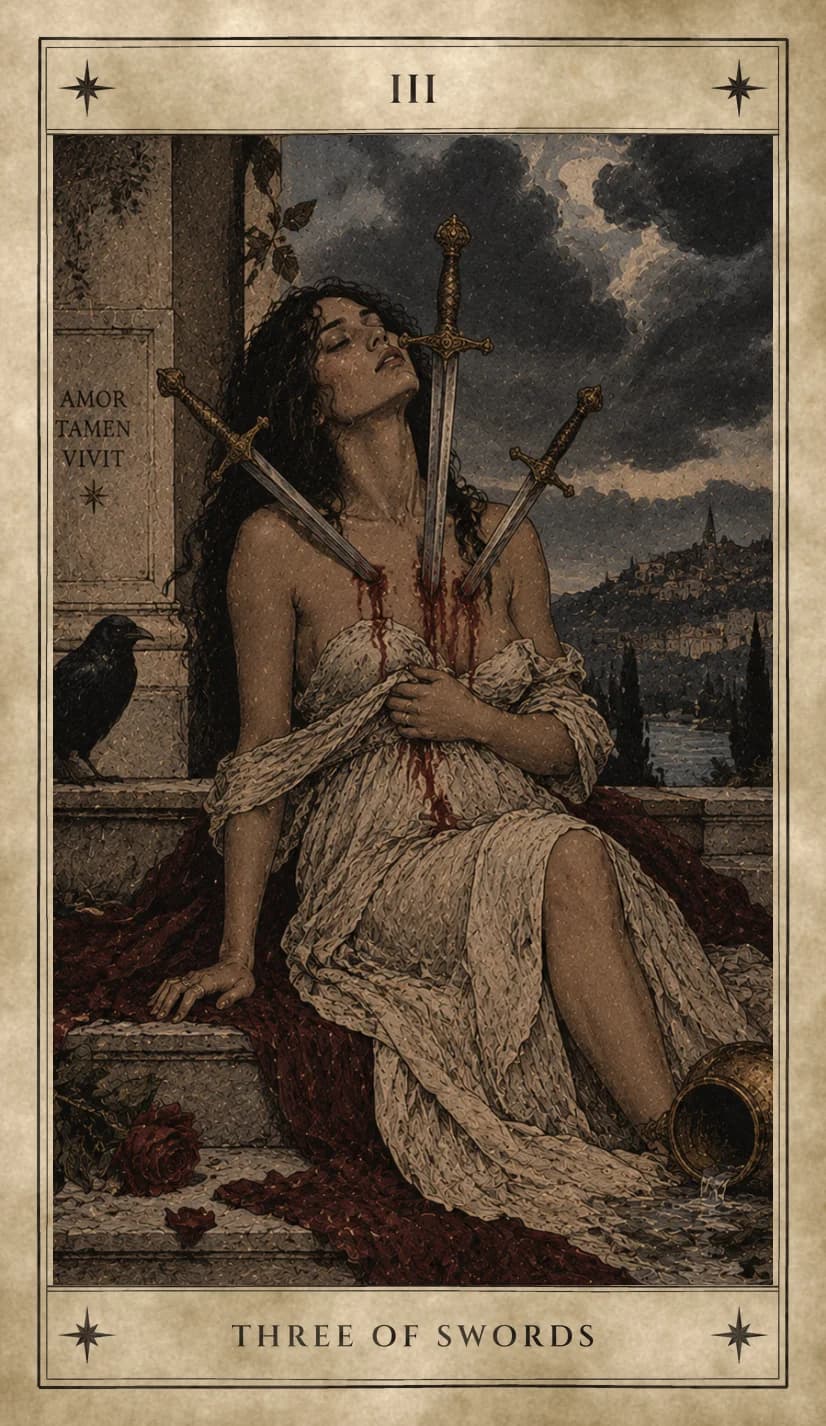
Our Three of Swords doesn't show a pierced heart hanging in the rain. It shows a woman. Her head is tipped back and her eyes are closed. She isn't pulling the swords out. One hand is pressed to her chest, holding rather than defending. This is a card about letting pain be where it is.
The raven on the ledge beside her is a witness, not a threat. She is not alone in this, even if it feels that way. It's also Raven, Feya's reader, which is part of why we chose her.
The overturned vessel and the fallen rose at her feet echo the Five of Cups: something has spilled that can't be poured back.
The inscription on the pillar, Amor tamen vivit, is Latin for “love still lives”. It's the card's quiet counterweight. The wound is evidence that the love was real.
Behind her, the storm hasn't cleared, but the town on the hill and the river are still there. Life on the other side of this goes on, even before she can look at it.
Love & relationships
This is the card most people fear in a love reading, and it's worth being honest about why. It often does point to heartbreak: a breakup, a betrayal, a truth about a relationship that changes how it looks. It doesn't decide the ending for you.
If you're single
An old heartbreak may still be deciding who you let close. That hurt taught you something true, but it may be teaching more than it should. Notice whether you're protecting yourself from pain or from anyone at all.
If it's new
Something is surfacing early: a mismatch, an unavailable person, a detail that doesn't sit right. Early is the kindest time to learn it.
If you're together
A painful conversation, a discovered lie, or a grief you're both carrying but not sharing. The card is sometimes read as a third person in a relationship. That's one traditional reading, not a verdict. Don't accuse anyone because of a card. If trust is the question, the card suggests the honest conversation is overdue.
If you're apart
The break is real. The card doesn't say it was a mistake, and it doesn't promise a return. It asks you to grieve what was actually there, not a version you've edited since.
Career & work
A rejection, a project cancelled after you'd put yourself into it, redundancy, harsh feedback, or a colleague who didn't have your back. It stings more when work is where you put your heart. The useful move is to separate the hurt from the information. The hurt needs time; the information may be worth keeping.
Money
A loss or disappointment, often tangled up with a relationship: shared money after a split, a loan to someone you trusted, grief spending. Make no large financial decisions while this card is loud. Write down what happened plainly before deciding what it means.
Grief is what love turns into when it has nowhere to go.
Inner life
That isn't a reason to rush it. The Three of Swords can mark a real turning in someone's inner life: the first time a loss is allowed to be as large as it is. The work is feeling it without letting it become the whole of who you are.
Reversed
Reversed doesn't mean “no heartbreak”. It usually means the heartbreak is moving differently. It can mean:
- Healing, slowly. The sharpest part has passed. You can talk about it without your voice changing, most days.
- Grief held in. “I'm fine.” The pain has gone underground, into the body, into irritation, into being busy.
- Reopening the wound. Going back to the person, the thread or the place to feel it again, sometimes just to feel close to what's gone.
- Beginning to forgive. Them, or yourself, for not seeing it sooner.
Which one it is often depends on the cards around it. Next to the Four of Swords, it leans toward recovery. Next to the Nine of Swords, toward rumination.
Questions to ask yourself
- What did I already know before it was confirmed?
- Where am I still arguing with something that has already happened?
- What am I grieving that nobody else has seen me grieve?
- If this hurt could ask me for one thing, what would it be?
- What is still alive in me after this?
Related cards
 The TowerWhen the truth arrives before you're ready.
 Five of CupsWhat grief looks like after the first shock.
 Nine of SwordsThe same wound at 3 a.m., on repeat.
 Two of CupsThe bond this card breaks, or tests.
 Four of SwordsWhat the wound needs next: rest.
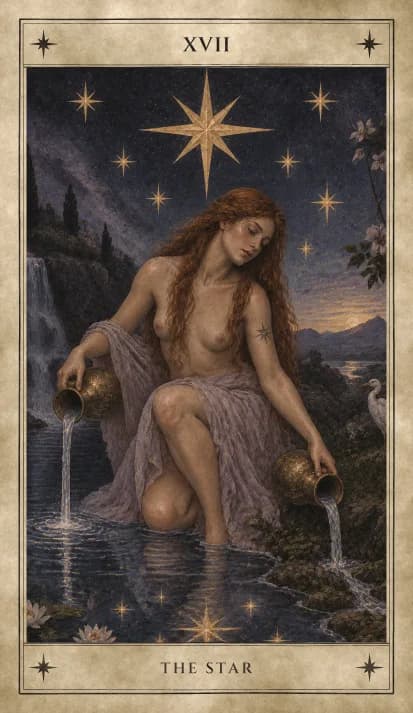 The StarWhat becomes possible when the wound stops being the whole story.
Short answers
Is the Three of Swords a yes or no?
It leans no, or “not the way you hoped”, at least while this remains unresolved. But this card resists yes or no. It usually says the question itself hurts, and that deserves a longer look.
Does the Three of Swords mean cheating?
Not necessarily. Some traditions read three swords as three people, but the card far more often means grief, disappointment or a painful truth. A card is not evidence. If trust is the real question, it points to a conversation, not a conclusion.
What does it mean as feelings, or how someone sees me?
They're hurting, or feel hurt by the situation. It can describe grief they haven't said out loud, or a sense that something between you has been damaged.
Is it a bad card?
It's a painful card, and pretending otherwise doesn't help. It's also an honest one: it ends pretending, and grief is where healing begins.
Is the Three of Swords a Libra card?
In the Golden Dawn system it rules the second decan of Libra, Saturn in Libra, roughly October 3 to 12. Some readers use decans for timing. We offer it as tradition, not prediction.