Tarot card meanings / Major Arcana / The Hierophant
Major Arcana
The Hierophant Tarot Card Meaning
Wisdom that has lasted. The Hierophant asks you to look at the teachers, traditions and rules you’ve inherited, and keep what is true for you.
Upright
- tradition
- teaching
- belief
- belonging
- guidance
- commitment
Reversed
- questioning the rules
- rebellion
- dogma
- leaving a tradition
- your own path
See the astrology & tradition
Taurus is steady, patient and slow to change. The Hierophant carries that into belief: traditions that last because people keep them, for better and for worse.
The deeper meaning
The Emperor builds structure. The Hierophant, card five in the Fool’s journey, gives it meaning. This is where rules become rituals, and a way of doing things becomes a way of belonging to other people. The question the card carries is simple and never quite finished: what do you believe, and why?
In real life, the Hierophant shows up around teachers and institutions: a mentor, a school, a faith, a family tradition, a profession with its own codes. It can mean studying something properly, joining a community, marrying the way your people marry. It can also mean the quiet pressure to do things the way they’ve always been done.
Wisdom and obedience are not the same thing.
The card holds both at once, and that’s what makes it worth sitting with. Tradition carries real wisdom, much of it hard-won and older than any of us. It also carries habits nobody has questioned in a long time. The Hierophant doesn’t ask you to accept everything or reject everything. It asks you to look.
Handled well, this card is mentorship, belonging and the relief of not having to invent everything yourself. Handled poorly, it becomes conformity: believing things because you were told to, shaming people who don’t fit, handing your judgement to anyone with a title. At its best, the Hierophant is a teacher who wants you to need them a little less each year.
When this card appears
- Learnfrom someone who has already done what you’re trying to do.
- Examinea belief you inherited and never actually chose.
- Committo a practice long enough for it to teach you something.
- Findthe people who share what you value.
- Honorwhat tradition got right, even while you change the rest.
Feya After Dark
In the Feya card
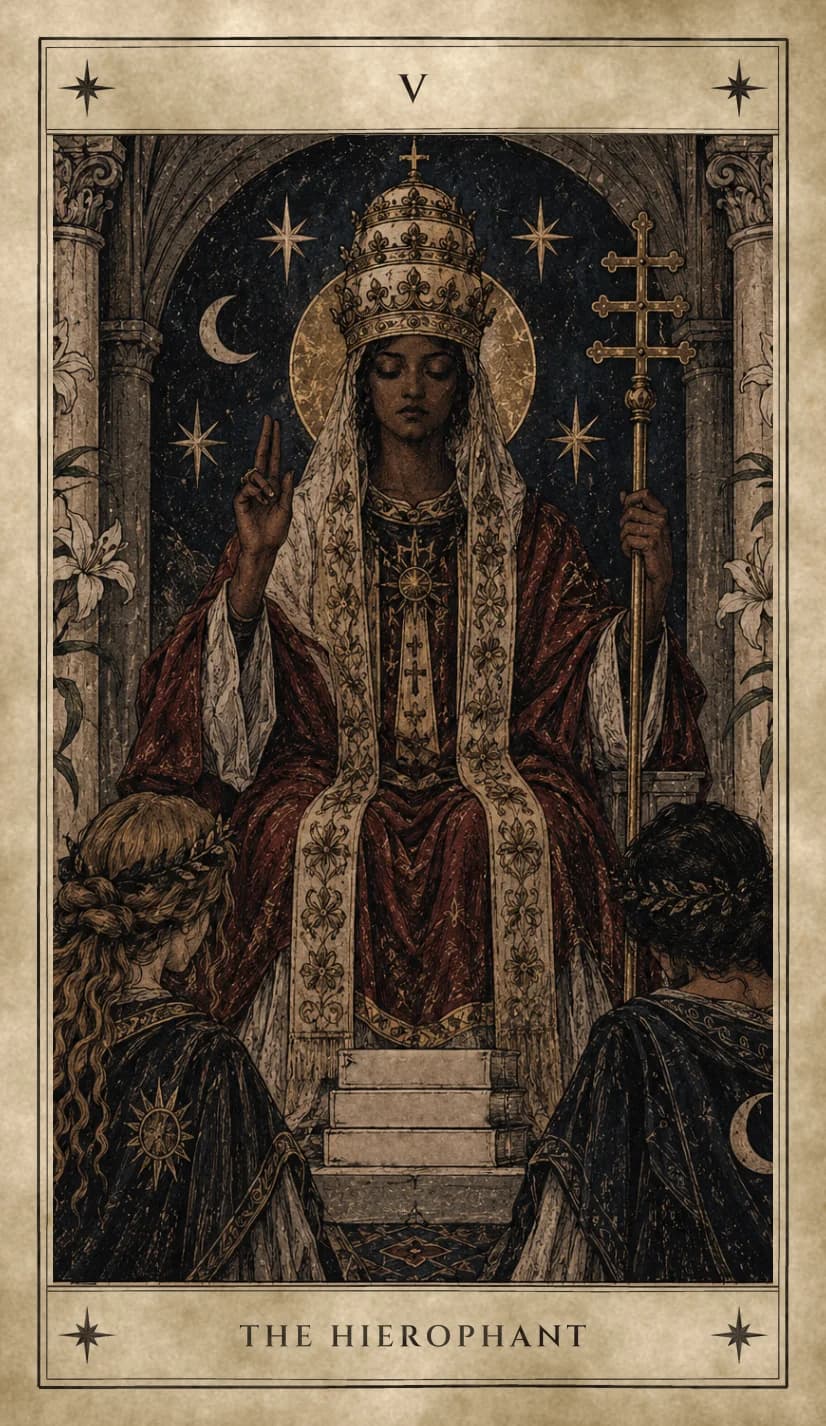
Our Hierophant is a woman. She sits enthroned beneath a dark arch, veiled, eyes closed, a gold halo behind a tall triple crown. One hand is raised in blessing; the other holds a gold cross with three bars. Her closed eyes matter. This is a teacher who listens inward as much as she speaks outward.
The two kneeling figures wear laurel wreaths and face her with their backs to us. One cloak bears a sun, the other a crescent moon. Two different people, two different natures, both come to learn. The card isn’t about sameness.
The raised hand, two fingers lifted, is the old gesture of blessing and teaching. It passes something on without holding on to it.
The stacked books make the step at her feet. What she rests on is what has been written down and handed forward.
The moon and stars in the arch echo the High Priestess. The Hierophant is her public counterpart: inner knowing brought out into a shared, spoken form.
White lilies climb the pillars on either side. The whole room is built for gathering.
Love & relationships
In love, the Hierophant points to commitment, shared values and relationships that follow a recognized path: engagement, marriage, meeting the family. It can also raise a quieter question: whose rules is your relationship following, and do they fit you both?
If you're single
You may meet someone through a community, a class, a faith or a shared tradition. It’s also worth asking whether you’re looking for a partner or for a checklist someone else wrote.
If it's new
Values matter more than chemistry here. Notice early whether you want the same kind of life.
If you're together
A time for commitment, ceremony or deepening what you share. If there’s tension, it may come from different backgrounds or expectations. Talk about the rules each of you grew up with.
Career & work
Training, qualifications, mentorship, established institutions. Good for studying, learning a craft properly or working inside a large organization. It can also describe a job where fitting the culture matters. If you feel stifled by how things have always been done, the card asks whether to change the system from inside or find one that fits you.
Money
Conventional wisdom is probably right here: saving steadily, advice from someone properly qualified, the tested approach over the clever one. Be wary of any scheme that asks you to trust its authority instead of checking it.
A good teacher gives you a path, and the courage to leave it if you must.
Inner life
In your inner life, the Hierophant asks where your beliefs came from. Some you chose. Many were handed to you before you could choose. Neither kind is wrong. The work is knowing which is which, keeping the ones that still ring true, and letting yourself set down the ones that don’t.
Reversed
Reversed, the Hierophant is usually about your relationship to the rules. It can mean:
- Questioning. A belief or institution you trusted no longer fits, and you’re starting to say so.
- Rebellion. Breaking rules because they’re rules. Freeing, and sometimes just another kind of rule.
- Dogma. Holding so tightly to the right way that there’s no room for any other.
- Your own path. Leaving a tradition to find what’s true for you, with the loneliness that can bring.
Next to the Fool, it leans toward walking away to begin again. Next to the Devil, toward rules that have quietly become a trap.
Questions to ask yourself
- Which of my beliefs did I choose, and which was I given?
- Who taught me something I still carry, and what was it?
- Where am I following a rule I’ve never questioned?
- What would I want to pass on?
- Where do I belong, and what does belonging cost me?
Related cards
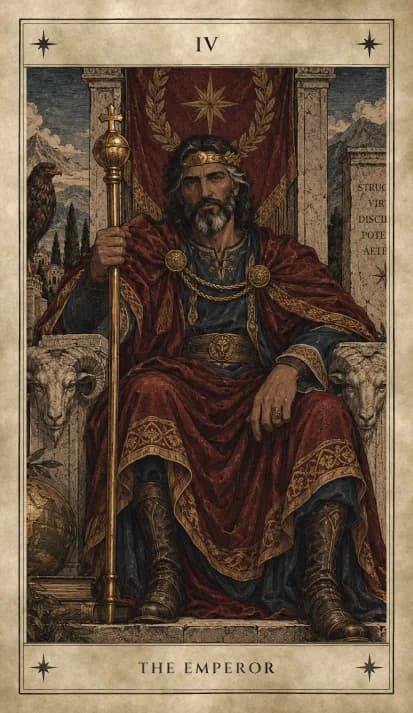 The EmperorStructure before it becomes shared belief.
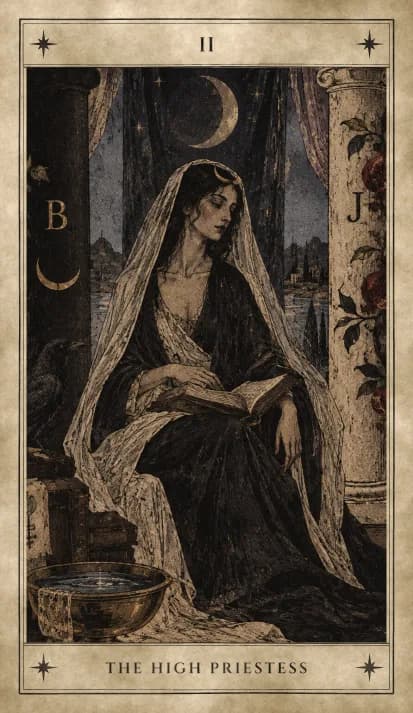 The High PriestessThe same wisdom, kept private rather than taught.
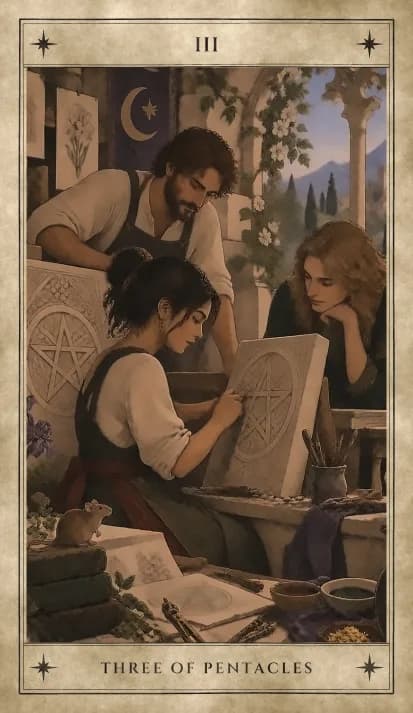 Three of PentaclesLearning a craft alongside people who know it.
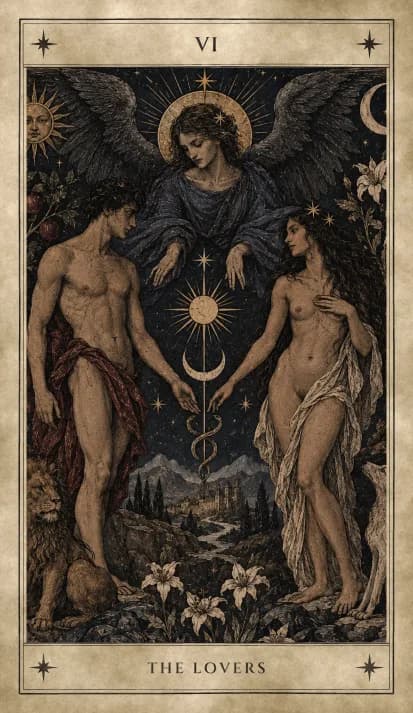 The LoversThe personal choice that follows the rules you were given.
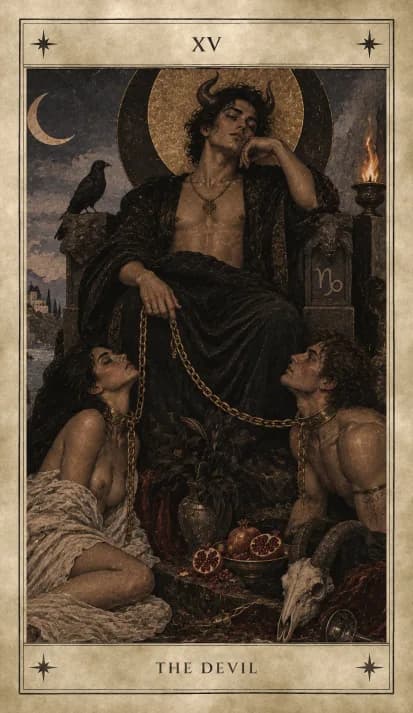 The DevilRules that bind instead of guide.
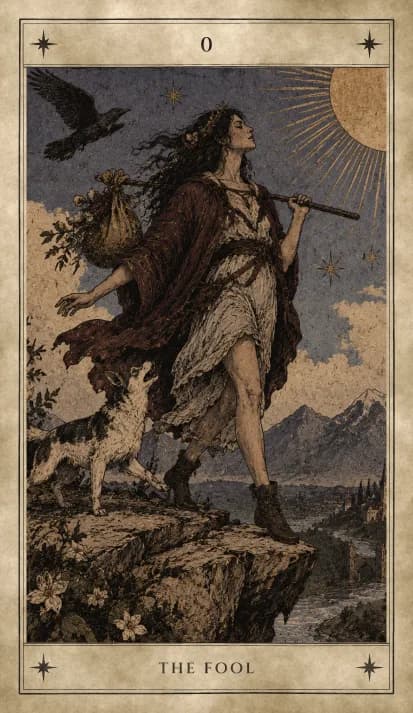 The FoolThe one who leaves the path to find their own.
Short answers
Is the Hierophant a yes or no?
It leans yes, especially for the conventional, tested route: the proper process, the recognized path, the advice of someone experienced. It leans less clearly yes if the question is about breaking away from what’s expected.
What does the Hierophant mean in love?
Commitment and shared values, often along a traditional path such as engagement, marriage or meeting the family. It also asks whether the rules your relationship follows are ones you both actually believe in.
What does it mean as feelings, or how someone sees me?
They may take you seriously, with an eye on commitment. They might also be thinking about how you fit into their family, faith or community, and what the people around them would think.
Does the Hierophant mean marriage?
It’s traditionally linked to marriage and formal commitment, and it can point there. More broadly it describes shared values and the structures people build their lives around. It doesn’t predict a wedding.
Is the Hierophant always a religious figure?
No. Many decks show a pope-like figure, and ours shows a woman. The card is about teaching and tradition, and can describe any mentor, institution or set of beliefs, religious or not.
Is the Hierophant a Taurus card?
In the Golden Dawn system the Hierophant is given to Taurus, roughly late April to late May. Some readers use this for timing. We offer it as tradition, not prediction.